
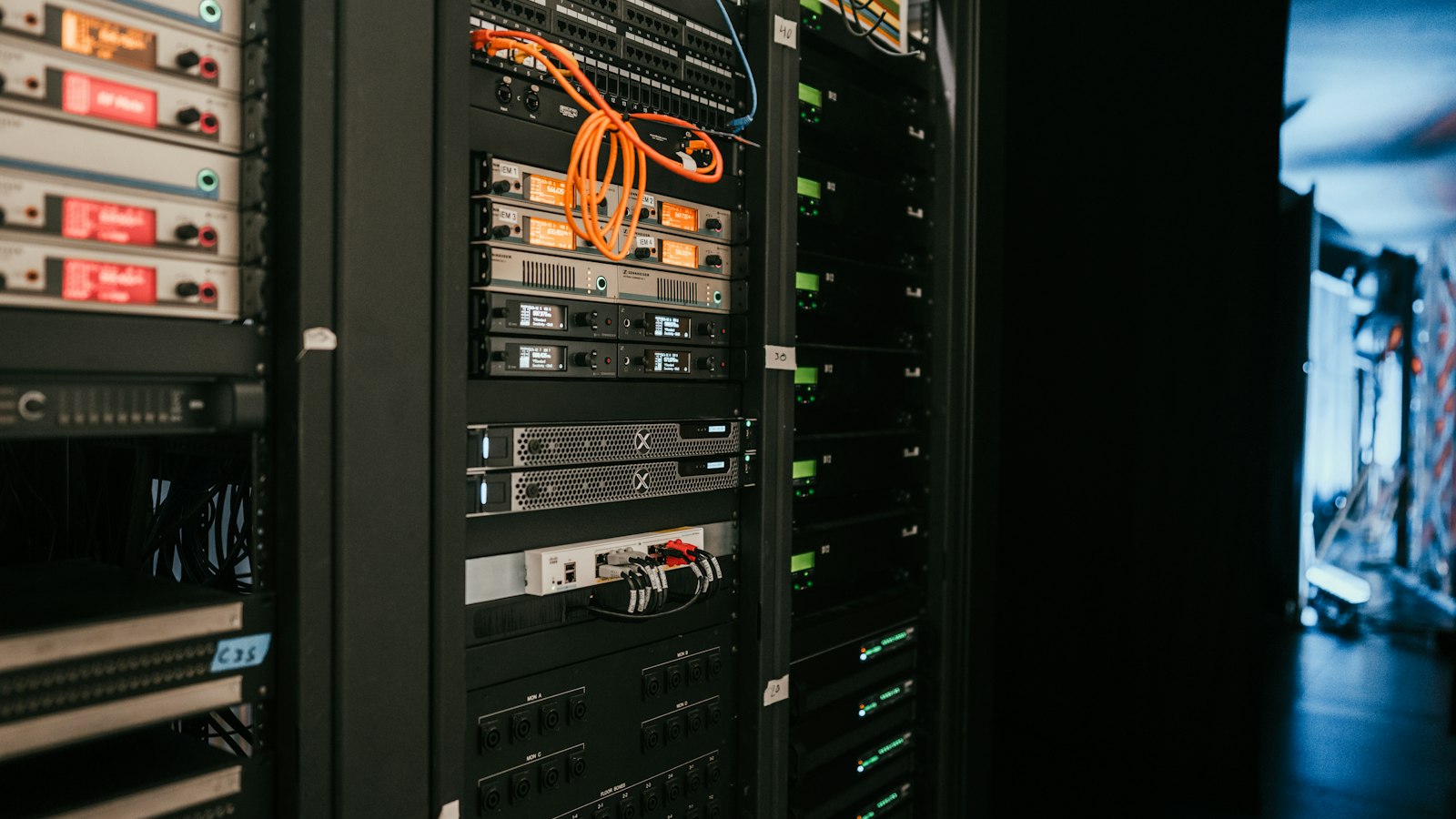
A server room is small, expensive to rebuild and full of ignition sources: dense cabling, power supplies, batteries and cooling equipment. It is also a place where water is the last thing you want. That makes fire protection for server rooms a design problem, not a product purchase. This guide walks IT managers through how the pieces fit together.
Key takeaway: the extinguishing agent is only one layer. Early detection, a sealed room and a safe, well-tested release sequence matter just as much as the cylinder.
Layered protection: detect, alarm, release, abort
Good server room protection works as a chain of events, each with its own safeguard.
- Early smoke detection. Servers smoulder before they flame. Very early warning smoke detection (aspirating systems that sample the air continuously) can pick up overheating cable insulation long before a conventional detector would. Many designs pair it with standard spot detectors.
- Alarm. The fire alarm panel signals the building and notifies the people who can investigate, ideally before any gas is released.
- Release. Two independent detection signals (cross-zoning) confirm a fire, a pre-discharge alarm sounds, and after a short delay the clean agent discharges.
- Manual abort and manual release. A person inside the room must be able to stop a discharge, and someone outside must be able to trigger one.
The detection side of this chain is a fire alarm design in its own right. If you are choosing between system types, our comparison of addressable and conventional fire alarm systems helps you decide how the panel should be built.
FM-200 vs Novec 1230 vs inert gas
Three families of agent dominate server room installations. They all put out fires without leaving residue, but they differ in the ways that matter to you.
FM-200 (HFC-227ea)
- Compact storage, widely installed and well understood.
- Refill is generally easy to arrange in India.
- It is an HFC, so long-term supply and regulation are worth discussing with your engineer.
Novec 1230 (a fluorinated ketone)
- Stored as a liquid at room temperature and has a much lower global warming potential than HFCs.
- Typically costs more than FM-200, and refill availability should be confirmed before you commit.
Inert gases (nitrogen, argon and blends)
- Natural gases with no environmental concerns about the agent itself.
- They need more cylinders and more storage space because they are stored at high pressure and are used in larger quantities.
- Discharge creates a larger pressure change, so venting is more important.
For the cost angle, see what drives FM-200 system cost in India. If your concern is a wider set of industrial risks, such as panel rooms or generator rooms, read clean agent vs CO2 vs water mist.
Room integrity, ventilation shutdown and pressure relief
A clean agent only works if it stays in the room at the right concentration for long enough. That depends on the room, not just on the cylinder.
- Seal the room. Close gaps around cable trays, pipes and ducts, and check the ceiling void and raised floor, which are part of the protected volume.
- Test it. A door-fan test measures leakage and predicts how long the agent will hold. Do it at commissioning and again after any major change to the room.
- Shut down ventilation. Air handling units and dampers should stop and close before discharge, otherwise the agent is pulled out of the room.
- Relieve the pressure. Discharge raises pressure in a tight room. Pressure relief vents prevent damage to walls, doors and ceilings.
- Control the power. Decide in advance whether equipment power trips on discharge, and make sure that decision is documented.
Mistakes that cause failed discharges or false triggers
Most failures we see in the field are design or maintenance problems, not equipment defects.
- Room changes after commissioning. New cable penetrations, a removed ceiling tile or a new door grille break the seal and nobody retests.
- Single detection path. One detector triggering discharge is an invitation to an accidental release. Cross-zoning exists for a reason.
- Ventilation left running. The dampers or air handling interface was never connected or was disabled.
- Abort station out of reach. It is hidden behind racks or not clearly labelled.
- No servicing. Cylinder pressure or weight is never checked and nobody knows the system has a slow leak.
- Dust and construction work. Dust triggers detectors. Cover or isolate them during work, and restore them afterwards.
- Untrained staff. People do not know what the pre-discharge alarm means, so they stay in the room when it sounds.
Routine testing prevents most of these, and our fire alarm maintenance checklist shows how to build it into a schedule.
A short checklist for IT managers
- Do we have both early smoke detection and conventional detection?
- Is the release cross-zoned, with a pre-discharge alarm and abort?
- When was the last room integrity test?
- Are ventilation shutdown and power control tested together with the system?
- Do we know where refills come from and how long they take?
- Does anyone on the team know what to do when the alarm sounds?
Talk to KBI
Get a server room fire risk assessment. KBI will review your room, detection, sealing and existing suppression, and tell you plainly what is missing. See our Fire Suppression System and Fire Detection & Alarm System pages, or contact us.